

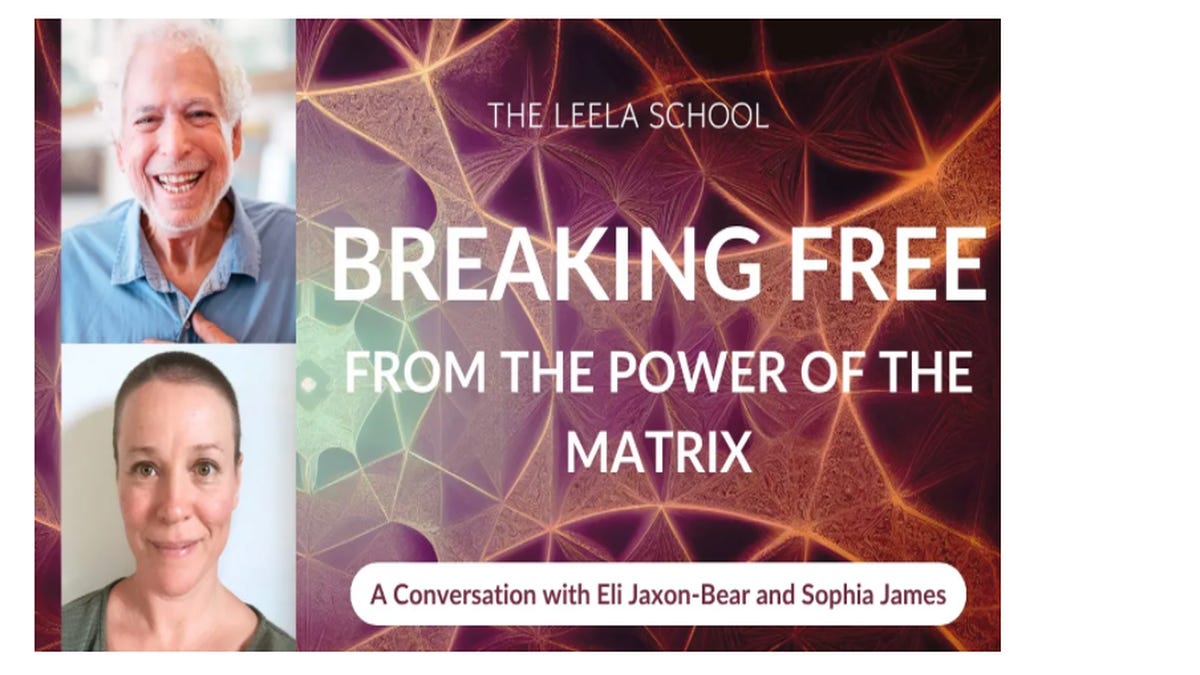
“Most people don’t want to wake up from the dream. They want a better dream.”
A new video conversation with Eli Jaxon-Bear on what The Matrix still shows us over 25 years later — and what it costs to keep choosing the better dream over waking.
In This Conversation
1:24 — What the Matrix actually is: a global trance induction
3:26 — Why most people don’t want to wake from the dream
4:35 — Cypher’s bargain, and the taste of the better dream
7:50 — Why fighting the government is still the Matrix
9:31 — How you actually step out: be Spartacus
10:35 — The veil lifts: a retreat, and seeing home again
13:19 — Red pill, blue pill, and the psychedelic threshold
15:51 — When AI out-diagnoses the doctors
17:23 — Spengler’s forecast: the West at the year 2000
19:19 — “But now I’m a good German”: staying true anyway
A Note on the Record
Before publishing, I asked Claude (Anthropic) to fact-check this conversation. Claude: Two moments are worth a footnote — not because they’re wrong in spirit, but because the record should be exact.
Spengler. Eli calls Oswald Spengler “the first person who saw that societies are organic organisms.” Spengler gave that idea its most rigorous form in The Decline of the West (1918–1922) — cultures as living things, each with its seasons and its fixed span. But he wasn’t first. Ibn Khaldun mapped the organic rise and decay of dynasties in the Muqaddimah in 1377; Vico traced the recurring cycles of civilizations in 1725. What is genuinely arresting about Spengler is the schedule: writing before the First World War, he placed the West’s “pre-death emergency” around the year 2000, followed by some two centuries of Caesarism — the strongman standing in for institutions that no longer hold. That part he got eerily right.
AI and diagnosis. Eli’s account of AI out-diagnosing physicians is grounded in a real, widely reported study (Goh et al., “Large Language Model Influence on Diagnostic Reasoning,” JAMA Network Open, October 2024). Fifty physicians worked through unpublished case histories: those using conventional resources scored a median 74 percent, those also given ChatGPT scored 76 percent — barely better — while ChatGPT working alone scored about 90 percent. As Eli says, the doctors tended to overrule the machine, treating it as a search engine rather than trusting its full reading of the case. A real and sobering result — and also a single bounded study of reasoning on written cases, not a final verdict that machines diagnose better than doctors. A signpost, not a conclusion.
The point of the film, and of this conversation, survives both corrections intact.
Sources: Spengler, The Decline of the West (1918–1922); Ibn Khaldun, Muqaddimah (1377); Vico, The New Science (1725); Goh et al., JAMA
Thank you so much for this truth. I know this to be true! This message is so profound and important.
Wow! Brilliant! ❣️❣️❣️